Essay
Shelley Saywell's The War at Home and the women who leave
Saywell's film for CBC Firsthand followed women who had fled abusive partners and the people who help them. It belongs to a difficult genre, one that has to film women whose safety depends on not being found.
Titles with the word war in them usually promise distance: another country, another decade, footage of a place the viewer will never see. The War at Home turns the promise inside out. Shelley Saywell's documentary, made for CBC's documentary strand Firsthand and broadcast in 2016, is about women in Canada who flee violent partners, and about the people who help them get out. The war of its title is the kind fought in kitchens and bedrooms, behind doors that look like every other door on the street.
The borrowed word is not a stretch. When CBC Radio's The Current took up the film in March 2016, it framed the conversation around Canada's failure to help women flee partner violence, a sharper charge than the title makes. Wars have front lines and casualties. They also have refugees. The women at the centre of this kind of film are, in the most practical sense, refugees from their own homes.
Leaving is the dangerous part
Popular talk about partner violence still drifts toward the wrong question, the one about why she stays. Films like Saywell's begin at the other end. Leaving is the event, and it takes money, somewhere to sleep, a plan for the children, documents that may be locked in a drawer the partner controls, and a phone he may be able to track. Advocates and researchers have said for years that the period around separation can be the most dangerous of all.
Then comes the question of where to go. Shelters in Canada frequently turn women away because they have no room. A documentary about women fleeing violence is therefore also a documentary about infrastructure: beds, staff, funding, waiting lists, the drive from a rural house to the nearest safe place. Television tends to underplay that side of the story, because a waiting list is hard to film. It is also the side that decides how many of these stories end.
That is why the helpers matter as much as the women in a film of this kind. Shelter workers, advocates, a sister with a spare room, a legal clinic that knows which forms to file: these are the people who turn a decision into a plan. When a documentary gives them screen time, it is not wandering from its subject. It is showing the machinery a woman needs to get out, and the places where that machinery runs short.
Consent under pressure
Every film in this genre has the same problem at its core. Its subjects are in danger, and the danger comes from someone who may one day watch the film. Consent here cannot be a signature collected on the first morning of the shoot. A woman who agrees to be filmed in the first weeks after leaving is deciding under enormous pressure. Six months on, with a new lease, a custody hearing pending, or a partner who has learned her new address, she may see the whole thing differently.
Careful productions treat consent as something renewed rather than banked. They explain, in plain terms, where the film will be shown and how long it is likely to circulate. They agree in advance what a participant can withdraw, and until when. They ask about children, siblings, employers and friends, everyone whose life could be traced back through hers. Our essay on consent, safety and anonymity when filming survivors sets out these obligations at length. In films about women who have fled a partner, they are not abstract at all.
There is a second consent to think about, the shelter's. Staff who open their doors to a crew are vouching for it to residents who did not ask to be filmed and may not want to be seen even in the background. A production that understands this works on the shelter's terms, not the other way round.
What hiding costs a picture
Protecting someone's identity is a craft problem as much as an ethical one, and each tool has its price. The usual options, and what they cost:
- Blurring or pixelating a face. Audiences understand it instantly, but a blurred face reads to many viewers as a suspect or an informant in a news report. Used carelessly, it can make a survivor look like the one with something to hide.
- Altering the voice. A voice is as recognizable as a face to anyone who has lived with the speaker, so this is often necessary. The cost is warmth: a processed voice puts a pane of glass between the woman and the audience.
- Silhouettes against a window. Handsome on screen and widely used, but a profile can still be known to someone who knows the person well, and the look has hardened into a crime-television cliché.
- Hands, backs and belongings. Filming a woman's hands while she talks, or the few things she carried out of the house, can be more intimate than a face. It asks more of the editor and of the viewer.
- Masking places. Street signs, house numbers, licence plates, school crests, the view from a window and any distinctive building all have to go. A face can be hidden perfectly while a street corner gives the address away.
- Changing names. Common and sensible, provided the film tells its audience it has done so.
The best work in the genre makes this distance part of its meaning instead of apologizing for it. A woman seen only in fragments is an honest picture of someone who has had to break her life into pieces to stay safe. Handled carelessly, the same techniques turn her into an anonymous type. Handled well, they let a viewer feel what it costs to be unfindable.
The interview chair, and what not to reconstruct
Interviewing someone newly out of a violent home is not ordinary interviewing. Trauma-informed practice asks the filmmaker to let the subject set the pace, to share questions in advance, to accept that some events will come out of order or not at all, and to stop when asked without making her feel she has let anyone down. The aim is an account she recognizes as her own, not the most harrowing version available. Our guide to shooting documentary interviews covers the practical side, and some of it matters more here than anywhere: a subject who can see the door and is not boxed in by stands and cables is more likely to stay in the chair.
The other temptation is reconstruction. Restaging an assault with actors and moody light is a cheap way to make violence visible, and it nearly always turns testimony into genre. It tells an audience the story needs dressing up, and it borrows the grammar of thrillers for something that should never thrill. Stillness serves better. An empty hallway, a closed door and a woman's account in her own words will do more than any re-enactment.
After the broadcast
A film's obligations do not end on the night it airs. Broadcast documentaries get clipped, uploaded, shared and rediscovered years later, long after the people in them have moved on or moved again. Responsible productions plan for this with the women involved and with the shelters and community organizations that introduced them. That means a safety plan for broadcast week, a check-in afterward, and an agreed answer to the question of what happens if a participant's circumstances change.
Good practice also gives the audience somewhere to go: information about local services at the end of the film and on the broadcaster's site. Someone watching on her couch may be recognizing her own life on screen for the first time. The end card is written for her.
The company it keeps
The War at Home belongs to a small, serious body of films about women and violent partners. Cynthia Hill's Private Violence (2014) looked at domestic violence in North Carolina. Olivia Klaus's Sin by Silence (2009) is about women imprisoned for killing their abusers, the far end of the story this genre keeps trying to interrupt.
Saywell's earlier films on so-called honour killings, Crimes of Honour among them, dealt with women threatened by fathers and brothers rather than partners. The kinship with this film is plain. In both, the danger comes from inside the family, and the people who matter most are the ones who give a woman somewhere to go.
Renfrew County, six years on
In 2015, Carol Culleton, Anastasia Kuzyk and Nathalie Warmerdam were murdered in Renfrew County, Ontario. The coroner's inquest into their deaths ended in 2022 with a jury recommendation that Ontario declare intimate partner violence an epidemic, and many Ontario municipalities went on to pass such declarations of their own. Groups that track femicide in Canada have reported for years that, on average, a woman or girl is killed roughly every two days, most often by a male partner.
The inquest came six years after The War at Home aired. The film's central complaint, that women trying to leave were not getting the help they needed, had not gone out of date. Anyone coming to it now should watch with that in mind, and spare a thought for whoever in their own town answers the phone at a shelter at three in the morning.
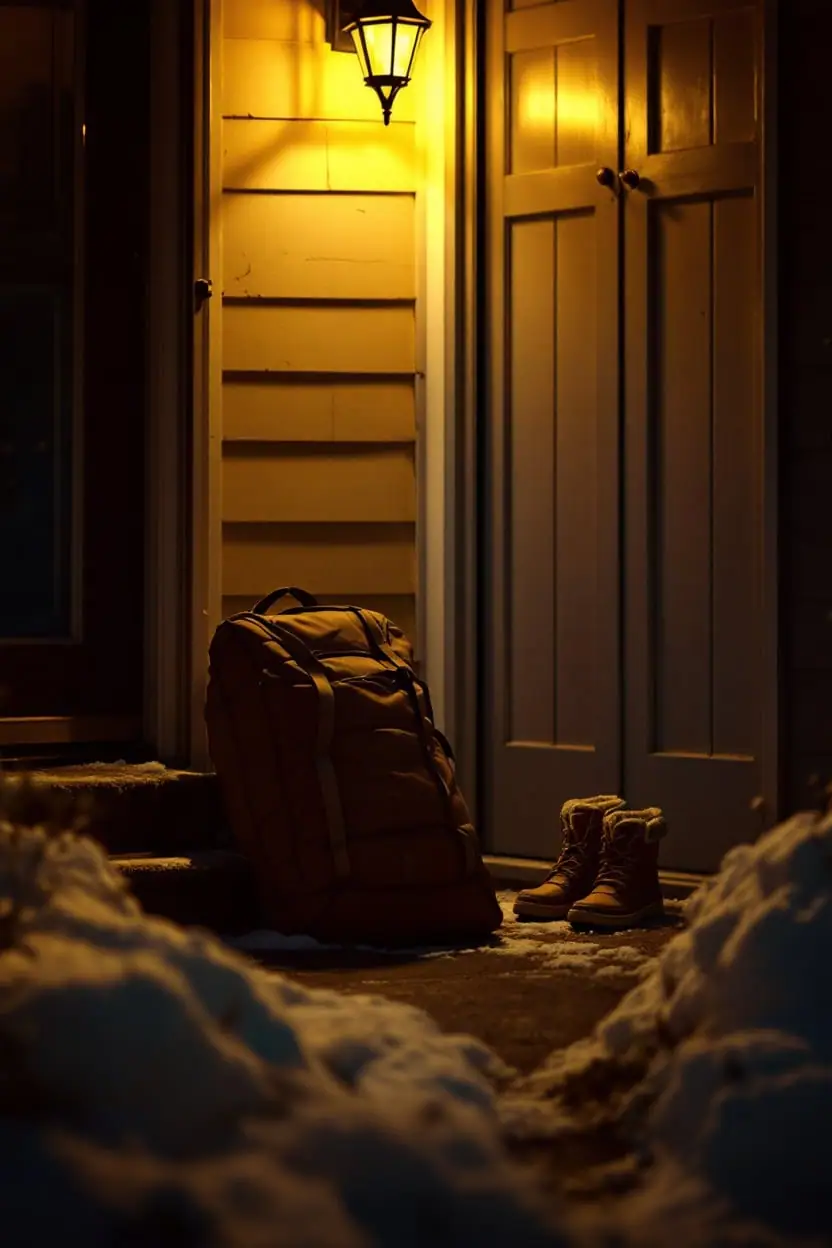
The genre keeps returning to the moment just before a woman goes: a bag packed and hidden, boots for the children by the back door, the porch light left off. A film like this one is made so that when she opens that door, there is somewhere on the other side to go.