Filmmaking Craft / Canadian Cinema
The 180-degree rule in film, and why documentaries break it
The 180-degree rule in film explained: the line between two people, screen direction, honest ways to cross it, and why documentary crews cross it so often. Some links here are affiliate links. As an Amazon Associate I earn from qualifying purchases.
In this piece (8 parts)
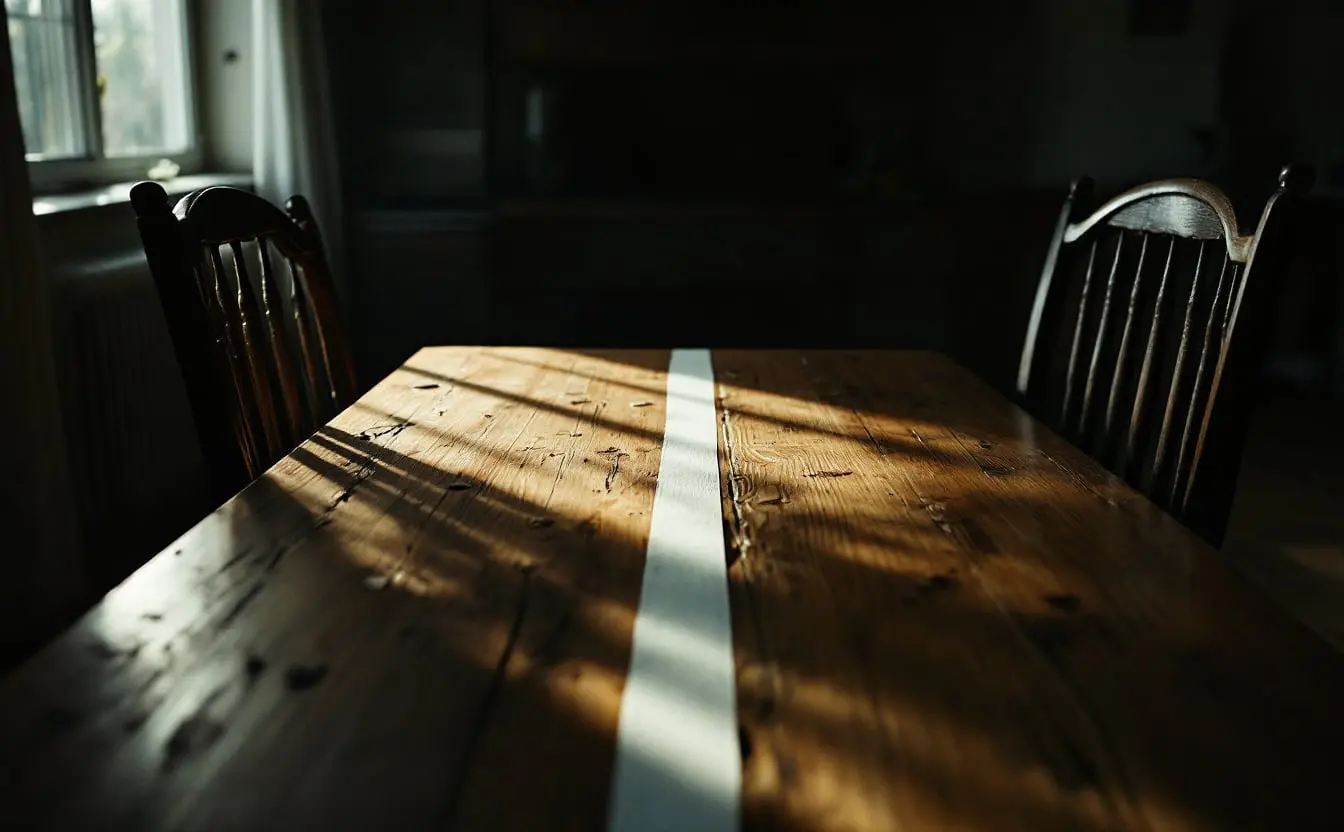
Picture two people at a kitchen table, one by the window and one by the stove. Run an imaginary line through their heads and on across the room. That line is the whole of the 180-degree rule in film: keep the camera on one side of it, and the person by the window stays on the left of the frame looking right, while the person by the stove stays on the right looking left. Put the camera on the far side for the next shot and they appear to swap chairs between one cut and the next.
The rule is one of the oldest habits of continuity editing, settled by commercial filmmakers in the silent years so that nobody in the audience would have to stop and wonder where anyone was. Documentary makers learn it at school and then spend their working lives crossing it, mostly by accident and now and then on purpose. What follows is the rule, the honest ways around it, a master who ignored it, and what an editor does when the rushes have already gone over the line.
What is the 180-degree rule in film?
The imaginary line goes by several names: the axis of action, the 180-degree line, or just the line. It runs between the two people in a conversation, or along the path of anything moving through the frame. The camera may go anywhere in the half circle on one side of it, close or far, high or low. That half circle is where the 180 degrees come from.
Inside it, the grammar of a dialogue scene works without anyone thinking about it. Shoot an over-the-shoulder on the woman by the window, then turn around and shoot the reverse on the man by the stove, still from the same side. She looks screen right, he looks screen left, and when you cut between them they seem to look at each other. Cross the line for one of those shots and both of them look the same way. The audience reads it, for an instant, as two people staring at a third who isn't there.
Screen direction, and why viewers feel it
Movement follows the same logic. A canoe paddled from left to right along a shoreline should keep going left to right in the next shot, or the viewer reads it as turning back. Here the line is the direction of travel, and the camera stays on one bank.
Hockey broadcasts are a good everyday example. The main game camera sits high on one side of the rink, so a team attacking to the left keeps attacking to the left until the period ends and the teams change ends. When a replay comes from a camera on the opposite side, broadcasters often flag it on screen as a reverse angle, because otherwise the play appears to run backwards.
Most viewers have never heard of the rule. They still feel it when it breaks: a small jolt, half a second of sorting out who is where. In a fast exchange that costs attention just when you want the audience listening.
Three honest ways to cross the line
Crossing is allowed. What the rule really asks is that you take the audience with you. There are three standard ways to do it.
- Use a neutral shot. Put the camera on the line itself: someone walking straight toward the lens, or straight away from it, or a frontal shot with no clear left or right. After a neutral shot, the next one can come from either side, because the viewer has had a moment with no direction at all.
- Move the camera across while it is rolling. A dolly, a slow handheld walk around the table, or a pan that follows a person as they cross the room all carry the viewer over the line inside a single shot. They see the room turn, so nothing jumps.
- Cut away, then come back. A shot of hands, a kettle, a window or a dog breaks the chain, and the return can come from the other side. This is the weakest of the three. It works best when the cutaway is a wide shot that shows both people again and so resets the geography.
There is a fourth case that is less a technique than a fact. If a person gets up and walks around the table, the line moves with them. Action redraws the axis, and a camera that follows the action stays honest.
Ozu, who ignored it
Yasujiro Ozu, the Japanese director of Late Spring (1949) and Tokyo Story (1953), built a body of work that pays very little attention to the rule. In his conversation scenes the camera often cuts across the axis, so two people speaking to each other can both appear to look out the same side of the frame. His camera sits low, near the eye level of someone seated on the floor, and frames people almost head-on. David Bordwell and other critics have described his space as 360 degrees rather than 180: Ozu treats the whole room as available, with no fourth wall to protect.
Audiences adjust within a scene or two. I think the reason is consistency. Ozu breaks the same rule the same way, film after film, and so each picture teaches its own grammar early and then keeps to it. The lesson for documentary makers is a hopeful one. The rule is there to keep people oriented, and anything else that orients them (a steady visual system, clear sound, unmistakable faces) can do the same job.
Why documentary breaks the 180-degree rule constantly
A fiction scene is blocked, rehearsed and shot several times from planned setups. A documentary scene happens once. Nobody tells a fisherman where to stand while he mends a net, and nobody asks a couple to stay on their own sides of the argument.
Then there is the single camera. A small documentary crew usually has one, and the operator gets each moment only once. If the more interesting face is on the far side of the line, a good operator goes there, because the face matters more than the geography. Sound pulls the camera around too. The operator follows whoever is talking, and talk does not respect the axis.
Canadian documentary has a long history of this. When Michel Brault carried a camera into the crowd at a Sherbrooke snowshoe convention for Les Raquetteurs (1958), he gave up the outside position that the rule depends on; a camera inside a crowd has no edge to stay behind. I wrote about that film and the handheld cinema that grew from it in a piece on Quebec's direct cinema. Handheld observational films cross lines as a matter of course, and they hold together because the people and the sound carry you.
The one place documentary can keep the rule easily is the sit-down interview. Put two cameras on the same side of the subject's eyeline, as Teodora Vlahos sets out in her guide to shooting documentary interviews, and the editor can cut between a medium shot and a tighter one without anyone jumping. Across a whole film, some editors alternate the side of the frame from one interviewee to the next, so that people who disagree seem to face each other. Others keep everyone looking the same way for a calmer film. Both are choices, and both are better made on purpose.
How editors repair a crossed line
By the time footage reaches the cutting room, the line is wherever the operator left it. Editors have a short list of repairs, roughly in order of preference.
- Find the move. Somewhere in the rushes the operator walked around. That walk, even a few seconds of it, is a bridge.
- Use a wide. A shot that shows the whole room tells the audience where everyone is, and the next close shot can come from either side.
- Cut away. Hands, a cup, the view out a window. It works, though a film stitched together with cutaways starts to feel nervous. Teodora Vlahos covers the wider craft of building scenes from the rushes in her piece on editing a documentary.
- Let the sound carry. If one voice runs on across the cut, viewers forgive a surprising amount of visual jumping.
- Accept it. In a heated scene, a jolt can be truthful. Observational films live with crossed lines all the time.
Editing software will also let you flop a shot, mirroring it left to right so the eyelines match. In fiction this is common enough. In documentary it shows the world reversed: lettering reads backwards, a wedding ring changes hands, a part in someone's hair moves sides. My own view is that a documentary should not flop a shot of a real person if the mirrored image changes anything a viewer might learn from it, and that is nearly always.
Not to be confused with the 180-degree shutter rule
The same number turns up in a different rule about motion, and search results mix them up constantly. The 180-degree shutter rule says the shutter should be open for about half of each frame's time. At 24 frames per second that means roughly 1/48 of a second, which most cameras round to 1/50; at 30 frames per second, 1/60. Movement then blurs about as much as the eye expects. It has nothing to do with where the camera stands. If you need the numbers for an odd frame rate, the shutter angle calculator in our Kit Room works them out.
Questions
What is the 180-degree rule in film, in one sentence?
Keep the camera on one side of an imaginary line drawn between the people in a scene, or along the direction of movement, so that left and right stay consistent from shot to shot.
Is crossing the line always a mistake?
No. It is a mistake when it confuses the viewer without meaning to. A neutral shot, a camera move across the line or a well chosen cutaway gets you to the other side cleanly, and some directors, Ozu most famously, ignored the rule for whole careers.
What is a neutral shot?
A shot taken on the line itself, such as a person walking straight toward or away from the camera. It has no clear left or right, so the next shot can come from either side without a jump.
Does the rule apply to documentary interviews?
Yes, when there are two cameras or when the interviewer appears in frame. Keep both cameras on the same side of the subject's eyeline. With a single camera and one subject, the line only matters when you cut to something else in the same space.
Is the 180-degree rule the same as the 180-degree shutter rule?
No. One is about where the camera stands, the other about shutter speed and motion blur. They share a number and nothing else.