Climbing documentaries, from Touching the Void to Free Solo
A climbing documentary guide to Touching the Void, Free Solo, Meru, The Dawn Wall and more, with notes on filming risk and how cameras get up a wall. Some links here are affiliate links.
In this piece (10 parts)
I live in Winnipeg, a city so flat that the most serious ascent I make in a year is up a stepladder to change the letters on a cinema marquee. Naturally, I adore climbing films. A good climbing documentary gives a prairie person something nothing else does: the feeling of vertical space, of air under your heels, delivered safely to a seat with a cup holder.
They are also some of the most ethically interesting films around. Somebody has to hold the camera, somebody chose to be filmed doing something that could kill them, and the audience is there, in part, for the danger. Here are six films worth your time, from the rock climbing documentary that made Yosemite famous to the mountain epics, and some thoughts on what the cameras change.
Touching the Void (2003)
Kevin Macdonald's film tells the story of Joe Simpson and Simon Yates on Siula Grande in Peru in 1985: a broken leg high on the mountain, a rope that had to be cut and a long, solitary struggle back towards camp. Macdonald intercuts interviews with the two men and reconstructions of the climb, and the mix works on you in a peculiar way. You know both survived, because there they are, talking to you. The tension holds anyway.
The film won the BAFTA for Outstanding British Film, and it still sets the bar for how to use reconstruction honestly. The re-enactments are plainly re-enactments, framed by two men remembering. Nobody pretends a camera was there on the day. If the film grabs you, Simpson's own book, Touching the Void, is the account the film grew from, and it lets you sit longer inside his head than any film could.
Free Solo (2018)
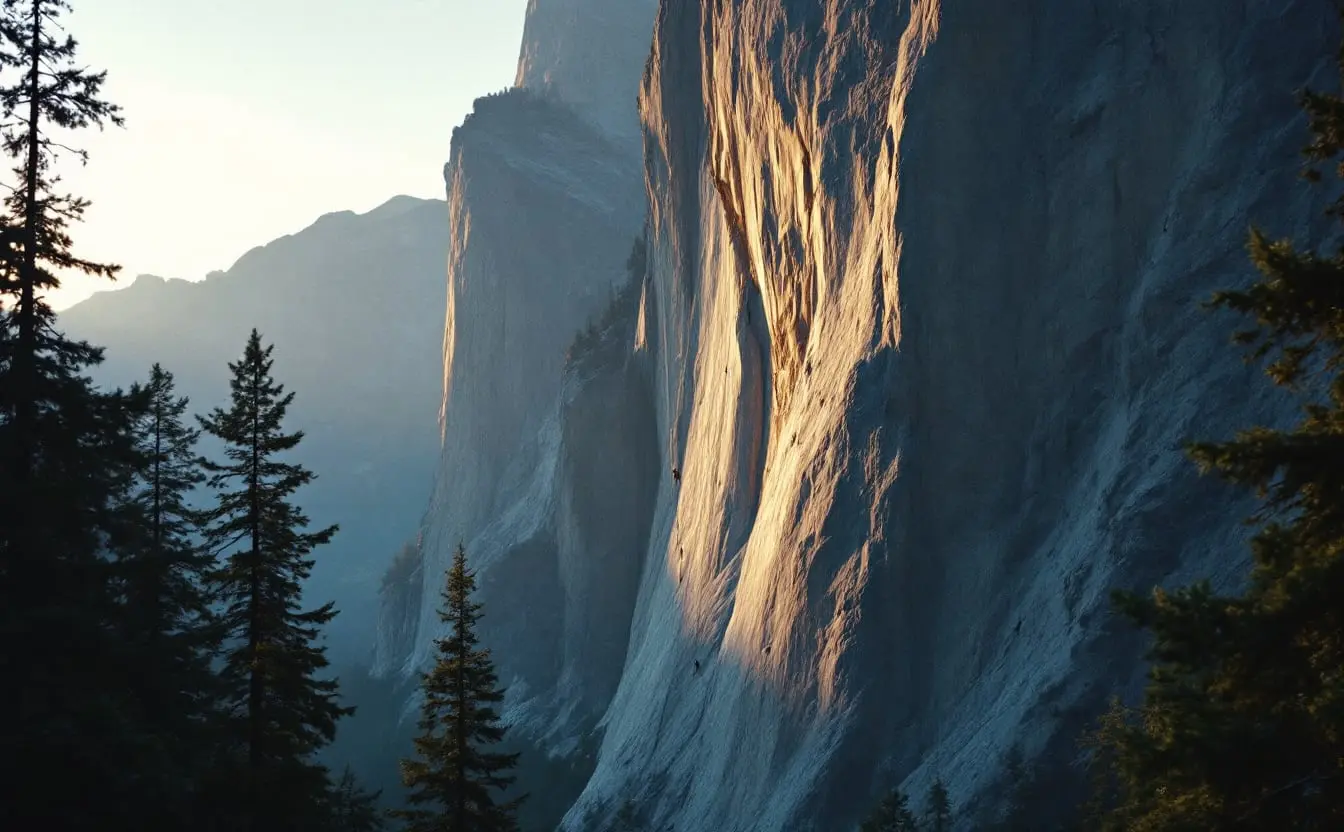
Elizabeth Chai Vasarhelyi and Jimmy Chin's film follows Alex Honnold towards his ropeless climb of El Capitan, which he completed on 3 June 2017. It won the Academy Award for documentary feature, and it earned it twice over: once for the climb, and once for being honest about its own position.
The film talks openly about a question most adventure films hide. Could the crew's presence, the cameras and the pressure of a film being made, influence the choices of a climber for whom a single mistake would be fatal? The filmmakers do not pretend to have an easy answer. That openness is the reason I recommend the film to people who say they hate sports documentaries. For Honnold in his own words, from before the film, Alone on the Wall, written with David Roberts, covers his climbing life up to that point. A note on method: I picked both books on their reputation and published reviews, so take them as a reader's suggestions.
Meru (2015)
Before Free Solo, Jimmy Chin and Elizabeth Chai Vasarhelyi made Meru, about Conrad Anker, Jimmy Chin and Renan Ozturk on the Shark's Fin of Meru in India. Yes, Chin is both on the rope and behind the camera, which makes it one of the best films for understanding what it means to shoot from inside a climb. The person filming is also one of the people who might fall.
It is a story about a team as much as a mountain, and about what friendship looks like when you are tied together. For my money it is the most moving of the group.
The Dawn Wall (2017)
Josh Lowell and Peter Mortimer's film is about Tommy Caldwell and Kevin Jorgeson's 2015 free climb of the Dawn Wall on El Capitan. Free climbing means the ropes are there only to catch a fall, not to pull yourself up on, so every metre of progress comes from fingers, toes and stubbornness. The project unfolded in public, with the world watching, and the film captures that strange mixture of solitude on the wall and attention from below.
It is also the gentlest entry point here. Nobody's life is on a single move in the way it is in Free Solo, so it suits family viewing with older children who like a long, patient struggle.
Valley Uprising (2014) and 14 Peaks (2021)
Two more for the list, from opposite ends of the sport. Valley Uprising is a history of Yosemite climbing, generation by generation, and it is the best primer on why that one valley matters so much to climbers. Watch it first and the others make more sense.
14 Peaks: Nothing Is Impossible follows Nirmal Purja's project on the world's fourteen peaks above 8,000 metres. It is high-altitude mountaineering rather than rock climbing, built on scale, logistics and endurance, and it makes a fascinating contrast with the quiet, technical films above.
The films at a glance
| Film | Year | The climb | Watch it for |
|---|---|---|---|
| Touching the Void | 2003 | Siula Grande, Peru, 1985 | Honest reconstruction and survival |
| Valley Uprising | 2014 | Yosemite's climbing history | Context for everything else |
| Meru | 2015 | The Shark's Fin of Meru, India | Shooting from inside the team |
| The Dawn Wall | 2017 | El Capitan's Dawn Wall, 2015 | Patience and a slow-burning story |
| Free Solo | 2018 | El Capitan without ropes, 2017 | The ethics of filming risk |
| 14 Peaks: Nothing Is Impossible | 2021 | The 8,000-metre peaks | Scale and endurance |
What makes a good climbing documentary
The best ones resist the highlight reel. Anyone can cut together a minute of beautiful exposure and dramatic music, and plenty of brand videos do. A film holds you when it makes you understand why a person would choose this, what it costs the people who love them, and how small the margins are.
Notice, too, how each film handles what it could not film. Touching the Void reconstructs and says so. The others mostly rely on footage shot at the time, which raises its own questions about what was staged, repeated or chosen for the camera. Asking how the camera got in is the second question in Claire Archambault's guide to watching a documentary critically, and climbing films make it unusually concrete: somebody literally had to haul that camera up there. The same eyebrow I raise at dinosaur reconstructions, which I wrote about in a guide to dinosaur documentaries, works on a mountain too.
The ethics of filming risk
Every film about dangerous climbing carries a quiet question: would this have happened, in this way, without the camera? A film brings money, schedules, sponsors and an audience. None of that has to be sinister, but all of it adds weight to a decision that should belong only to the climber.
Things I watch for:
- Does the film admit the crew's influence, or pretend the cameras were invisible?
- Does it show the people left on the ground, and the cost to them?
- When things go wrong, does the camera keep rolling for the drama, or does the film show restraint?
- Is the danger explained, or simply sold?
Free Solo is the clearest case of a film taking those questions seriously on screen, and that is a large part of why it is more than a stunt film. As a viewer, there is a question for you as well. If part of the thrill is the chance of a fall, it is worth noticing that in yourself.
Camera work at height
Filming a climb is its own craft, and mostly a brutal one. The camera operators are usually climbers themselves, hanging on fixed ropes rigged beside the route, often for days, with cold fingers and batteries that die in the wind. Forget the smooth glide I described in my guide to camera gimbals; on a wall, the shot is whatever a person dangling from a rope can hold steady.
From the ground, long lenses turn climbers into specks on a vast face, which is often the most frightening shot of all because it shows scale. Closer in, small cameras clipped to a helmet give the climber's own view. The best films mix the two, so you feel both the hand on the hold and the size of the wall around it.
A viewing order for a climbing season
If you are new to the genre, here is the order I would programme them in at a small film club, one a week through a long winter.
- Valley Uprising, for the history and the cast of characters, so later films land in context.
- Touching the Void, for pure storytelling, and a lesson in reconstruction done in the open.
- The Dawn Wall, for patience, friendship and a project that takes years.
- Meru, to see what changes when the person holding the camera is also on the rope.
- 14 Peaks: Nothing Is Impossible, as a change of scale, from a single wall to the highest mountains on earth.
- Free Solo last, on a night when you can stay and talk about it afterwards.
Watch with a climber if you can. They will point out the holds, groan at the hard moves and tell you which shots must have been miserable to get. And bring a friend who is scared of heights. Watch their knuckles.