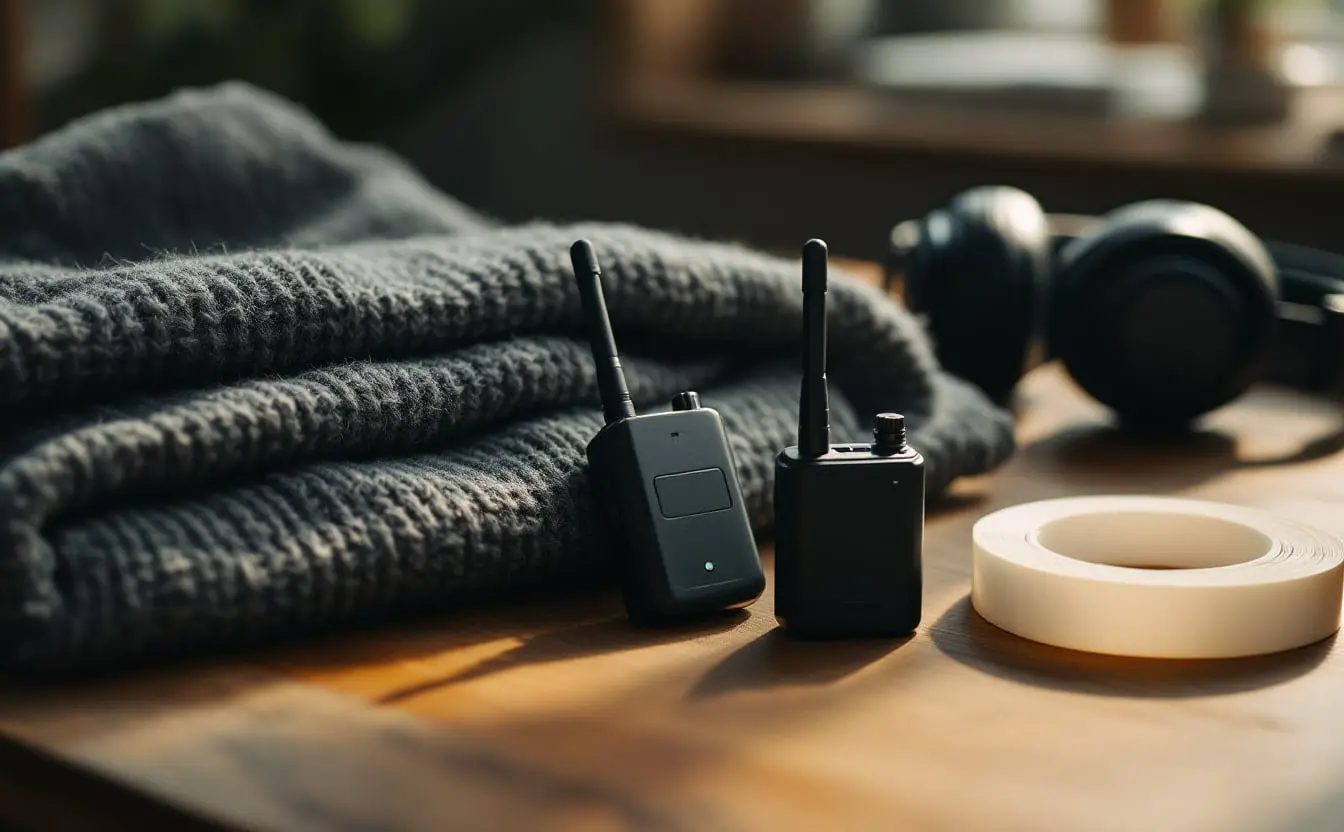
Boom mic and shotgun microphones for small documentary crews
Boom mic technique for small documentary crews: shotguns on camera or on a pole, boom stands, 32-bit float recorders, closed-back headphones and room tone. Some links here are affiliate links. As an Amazon Associate I earn from qualifying purchases.
In this piece (8 parts)
A boom mic held just above someone's head still gives the most natural voice you can get on a documentary shoot. I came to that late, after a couple of years of lav-only interviews that all sounded faintly as if they had been recorded inside a coat. The first time I cut a sit-down with a boomed shotgun next to the lav, I could hear the difference within a sentence. The boom had air around the voice: the room, a breath before the answer, the little click of a teacup going down.
This guide is for crews of one to three. It covers what a shotgun microphone does, when it belongs on the camera and when on a pole, how to hold a pole without ruining the shot, and what to record into. It follows the guide to lavalier and wireless microphones, and in practice you want both: the lav for safety, the boom for tone.
What a boom mic is, and how a shotgun hears
Strictly, the boom is the pole. The microphone on the end is usually a shotgun, and people call the whole rig a boom mic. A shotgun has a long slotted tube in front of its capsule. Sound arriving from the sides enters the slots at slightly different moments and partly cancels itself, so the mic is most sensitive straight ahead and much less so off to the sides.
That makes it directional, not magical. A shotgun is not a zoom lens; it does not pull a voice in from across a room. What it does is favour the voice over the room at any given distance. Distance still rules everything in sound, and a shotgun two metres away sounds like a shotgun two metres away.
Indoors there is a wrinkle. In small rooms with hard walls, reflections reach the mic from the sides, and the tube can colour them so the voice sounds hollow. Many recordists switch to a hypercardioid microphone for interiors for that reason. For a first kit, a short shotgun boomed close to the mouth works well enough in most rooms you will meet.
On-camera shotgun or boomed shotgun
A shotgun on top of the camera sits wherever the camera sits. For a medium shot, that is a couple of metres from the mouth, which is too far for clean dialogue in most rooms. It also hears the operator: breathing, hands on the lens, the shuffle of feet. On-camera mics earn their place elsewhere. They record ambience, the natural sound under B-roll, quick exchanges in run-and-gun scenes, and a scratch track that lets the editor sync a separate recorder.
Put the same microphone on a pole, half a metre or so above and in front of the speaker, and it becomes a different instrument. Nothing about the mic changed. Only the distance did.
On a small crew the useful trick is a mic that does both jobs. The Rode VideoMic NTG is a camera-top shotgun that can also go on a boom pole, so it rides on the camera for B-roll and moves to the pole for the interview. The Rode VideoMicro is a tiny on-camera mic with a shock mount, a clear step up from the built-in mic for ambience and handheld shots, and small enough to leave mounted all day.
Everything in these crew bags was picked from spec sheets, user manuals and the long track record these models have on small crews; I have not tested these exact units for this guide.
| Setup | Distance from the mouth | Good for | Weak spot |
|---|---|---|---|
| Built-in camera mic | Camera distance | A sync reference | Nearly everything else |
| On-camera shotgun | Camera distance | Ambience, B-roll, run-and-gun | Echo on dialogue indoors |
| Shotgun on a boom pole | As close as the frame allows | Natural dialogue, people moving | Needs an operator |
| Shotgun on a boom stand | As close as the frame allows | Seated interviews, solo crews | A subject who leans away |
| Lavalier | A hand's width below the chin | Steady level, walk-and-talk | Clothing noise, chesty tone |
Boom pole technique
Point the microphone at the mouth from above and slightly in front of the face. Not at the forehead, not at the top of the head, not at the chest. A shotgun aimed a little off the mouth goes thin and distant in a way that is hard to fix later, and with headphones on you will hear it happen as you tilt the pole. Booming from below the frame works in a pinch, under a low ceiling for instance, but it tends to sound chestier and hears more of hands and laps.
Stay out of frame by asking, not guessing. Have the camera operator call the frame line, dip the mic until it shows, raise it until it clears, then go up a few centimetres more, because people sit up straight and operators reframe. If you can see a monitor, glance at it often.
Watch for shadows too. A hard light will throw the pole's shadow across a wall or a face. Raise the pole, come in from another angle, or ask for the light to be softened. A big soft source casts much less of a shadow, which is one more reason to light interviews that way.
Cable management decides whether a pole is quiet. A loose cable slaps against the pole with every movement, and the mic hears it. Wrap the cable around the pole a few turns, snugly, or use a pole with a coiled cable inside. Hold the cable against the pole at your lower hand, and leave slack at the base so a step backward does not yank the recorder off a table. When you wrap for the night, coil it over-under so it lies flat next time.
Hold the pole firmly and keep your hands still; sliding a hand along the pole is audible. Let the shock mount absorb small bumps. Outdoors, a foam cover handles a light breeze, and a furry windshield over a basket handles real wind. In a long interview, rest the pole between questions, not during answers.
Field recorders, XLR inputs and 32-bit float
Most mirrorless cameras offer only a small 3.5 mm input and a preamp that adds hiss when you turn it up. A separate field recorder fixes both. XLR inputs carry a balanced signal that resists hum over longer cable runs, and the plugs lock, so a tug on the cable does not end the take. Many shotguns need phantom power through that XLR cable; check whether yours does and whether your recorder can supply it. Check, too, how a camera-top mic connects to the recorder, because the right cable is part of the kit.
The bigger change of the past several years is 32-bit float recording. An ordinary 24-bit file has a fixed ceiling, and anything louder clips, distorting the file for good. A 32-bit float file stores such a wide range that a sudden laugh or shout can be turned down in the edit with no damage. The Zoom F3 is built around exactly that: two locking XLR/TRS inputs, 32-bit float, battery powered. For a crew without a dedicated recordist, it removes the most common way to ruin an interview.
Float does not lower the noise floor or move the mic closer. Placement still matters, and so does sync. Feed a scratch track into the camera, clap once on camera at the start of each take, and let the editing software line up the files by waveform. Name and log your takes as you go, because two files per take adds up quickly over a long shoot.
A boom mic stand for the one-person crew
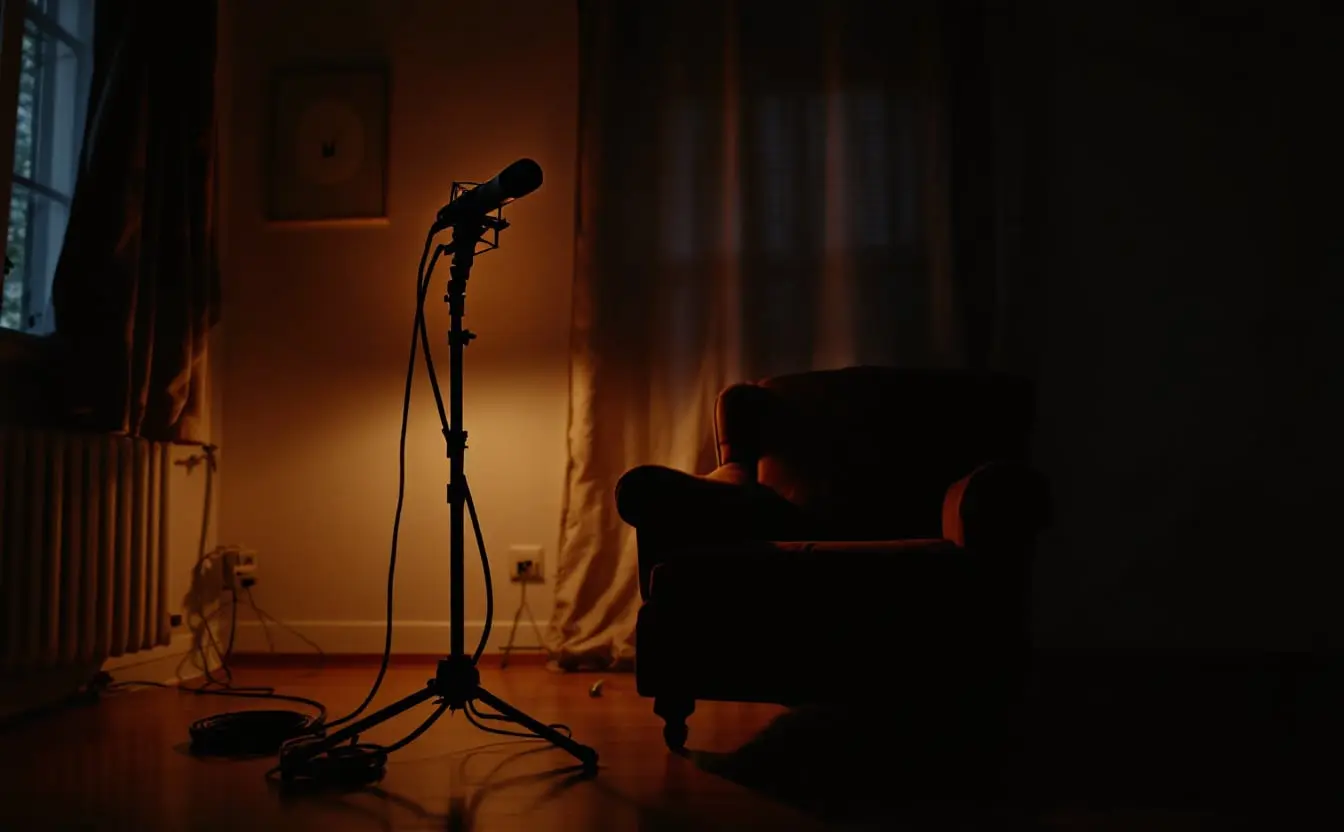
If you are shooting and interviewing at once, nobody is holding the pole. A boom stand holds the microphone just out of frame above a seated subject, and a light one like the Samson MK10 folds small enough to travel. Set it to one side of the camera, reach the arm over the subject, and aim at the mouth exactly as you would by hand. Hang a sandbag or a heavy bag on the base, because a stand with its arm stretched out tips more easily than it looks.
The weakness is that a stand cannot follow anyone. Ask the subject to sit back against the chair, keep a lav running as a second track, and check the pickup whenever they shift position.
Closed-back headphones
Headphones are the only honest meter you have. Closed-back models shut the room out, so what you hear is what the mic hears, and that is how you catch a mic drifting off the mouth, a cable tapping the pole, wind, a fridge, an aircraft. The Sony MDR-7506 has been a location-sound standard for decades, with a coiled cable that stays out of the way. The Audio-Technica ATH-M50x is another closed-back pair, with detachable cables, and it travels well for checking interviews in the field.
Pick the pair you can wear for ten hours. Comfort is a sound decision on a long day, because headphones that pinch end up around your neck by mid-afternoon.
Room tone before anyone moves
At the end of every setup, before the subject stands, record room tone: thirty to sixty seconds of the room with everyone still and every fan and light still running, the boom exactly where it was. Announce it, so the editor can find it, then hold the full time even though it feels endless. The editor will use it to fill every gap where a cough or a false start comes out. If the furnace switches on halfway through the day, record tone again with it running.
The section on sound in shooting documentary interviews covers how the boom and lav fit into the rest of an interview setup.
Questions
What is the difference between a boom mic and a shotgun mic?
The boom is the pole or stand that holds a microphone above the speaker, out of frame. A shotgun is a directional microphone with a slotted tube. Most boom mics on documentary shoots are shotguns, so the terms get used loosely.
Can a camera-top shotgun replace a boom?
For ambience, B-roll and quick exchanges, yes. For interviews, no: from the camera it sits too far from the mouth and hears the room and the operator. The same mic on a pole sounds far better.
What is a boom mic stand for?
It holds the microphone above a seated subject, just out of frame, when nobody is free to hold a pole. It suits solo crews and long interviews. Weigh the base down and keep a lav running in case the subject leans away.
Does a shotgun mic work indoors?
It works, but in small rooms with hard walls a shotgun can sound hollow because reflections reach it from the sides. Get it close to the mouth, soften the room with blankets or rugs, or use a hypercardioid indoors.
With 32-bit float, do I still need to set levels?
You no longer risk clipping the file, so gain matters much less. You still need the mic close to the mouth and the room quiet, because float recording does not remove noise or echo. Listen on headphones throughout.