Songs from the sidewalk: music documentaries and the street
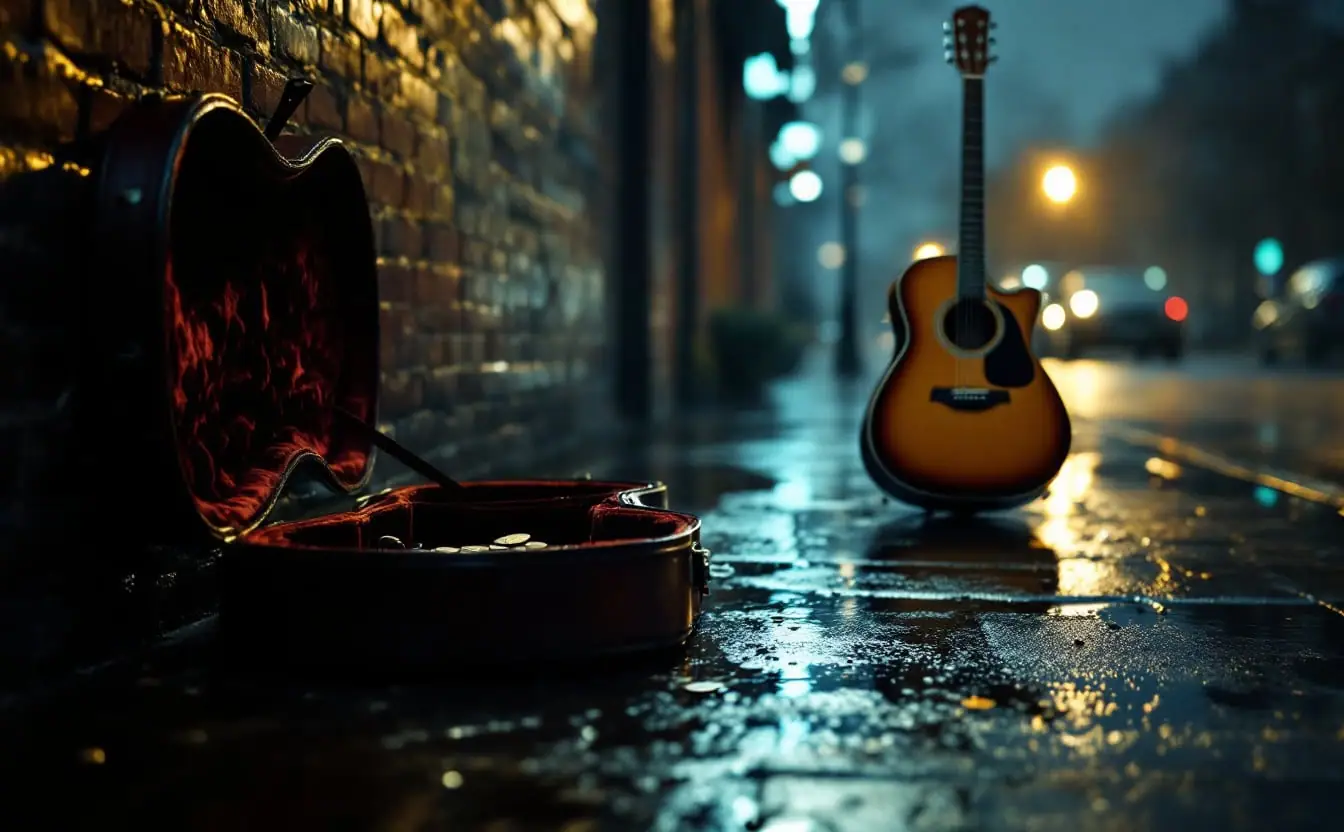
Most winters there is somebody playing guitar near a bus shelter on my route, fingerless gloves, case open at their feet, breath rising with every chorus. The acoustics are terrible. Buses hiss, a plow scrapes past, someone's phone goes off. And every so often a song lands so cleanly in all that noise that half the line stops scrolling and just listens.
Street music is the most democratic concert there is: no ticket, no stage, no guest list, and nobody is obliged to stay. Filming it is harder than it looks, technically and morally. The best documentaries about buskers, outsiders and people living on the margins have to solve both problems at once, and the way they solve them tells you a great deal about who the film thinks it is for.
Two ways to film a song
Broadly, music documentaries pull in two directions. The concert film is about the performance. It wants clean sound, good angles and the feeling of being in the best seat in the house; the audience, if you see them at all, is a chorus. The portrait is about the person. Songs become punctuation in a life, and the film is as interested in the kitchen and the bus ride as in the encore.
Wim Wenders's Buena Vista Social Club (1999) sits comfortably between the two. It has the polish of a concert film, yet it keeps stepping off the stage to sit with the players, and it trusts you to carry the music from one scene into the next. Malik Bendjelloul's Searching for Sugar Man (2012), about the musician Rodriguez, won the Academy Award for documentary feature, and it leans the other way. It is a portrait in which, to my ear, the recorded songs do a lot of the storytelling.
Both are lovely. Both also have a luxury that street films rarely get: control over where the music happens.
That control is worth thinking about. Put a busker on a lit stage with a good desk mix and you get a cleaner recording of a different person, because the hustle, the weather and the passers-by (the actual conditions of the work) simply vanish. Leave the street in and the sound gets rougher and, often, truer. Neither choice is wrong. But it is a choice, and an audience can hear which one you made.
When the street is the stage
Shelley Saywell's Lowdown Tracks (2015) is the film I keep coming back to on this subject. Saywell made it with the singer and activist Lorraine Segato of The Parachute Club, and it records street musicians in Toronto who were homeless or living on the margins, in the streets, under bridges and in shelters. It premiered at Hot Docs in 2015 and aired on TVO that November.
What interests me most is the premise. In a film like this the concert and the portrait collapse into one, because the place where a person plays is also the place where they sleep, wait and get moved along. You cannot frame the performance without framing the life. I also think it matters, as a matter of principle, that a working musician was part of making the film; a song gets heard differently when the people recording it know what it costs to write one.
There is a separate essay on this site about The War at Home, Saywell's film about women fleeing partner violence. Watched side by side, the two make an interesting pair for anyone thinking about how documentary handles people with few places left to go.
Recording sound where people actually play
The street is a mixing desk with no faders. Traffic, wind, coins dropping into a case, footsteps, a siren three blocks away: all of it is part of the performance, and some of it will bury the performance if you let it. Most crews in this situation want at least two kinds of sound at once. A close microphone on the voice and instrument gives you something clean enough to hear the words. A stereo pair, or a good ambient microphone, gives you the city around them.
Record those to separate tracks so the balance can be set later, in a quiet room, by someone with fresh ears. Bring proper wind protection, and more of it than you think, because a gust across an unprotected mic will ruin a verse you can never get back. Under a bridge you get concrete reverb and the low rumble of traffic overhead, which can sound magnificent or like a dishwasher. Shelters have hard floors, ventilation hum and other residents who never agreed to be on your soundtrack, so check what your microphones are picking up as carefully as what your lens sees.
The camera changes the crowd
There is a catch nobody warns you about. The moment a camera appears, the street stops being the street. A small crowd gathers because filming is happening, not because of the song, and suddenly the busker has an audience that would not have been there on an ordinary Thursday. Some people play up to the lens. Others drift off, embarrassed, and take the real atmosphere with them.
Small crews help. One person on camera and one on sound, dressed for the weather rather than for a set, will disappear faster than a team of five with a cart. Longer takes help too. Roll before the first chord and keep rolling after the last one, because the moments when the musician counts coins, retunes or chats with a regular are often more revealing than the chorus. If you need a wide shot of the corner, get it on another day, from across the road, so the scene has a chance to forget you.
Whole songs, not snippets
Record whole songs, even if you plan to use thirty seconds. The musician deserves to be heard start to finish, and the edit will want choices. For the sit-down conversations between songs, the sound advice in Teodora Vlahos's guide to shooting documentary interviews holds up in a stairwell as well as it does in a living room.
Filming people who have no door to close
The ethics deserve more than a paragraph, so here are the questions I would want any crew to answer before the camera comes out. None of them is settled by a release form alone.
Is consent a form or a conversation?
A conversation, and an ongoing one. Someone who agreed on a sunny afternoon may feel differently after a hard week, and they should be able to say so. Check in again before the cut is locked, and again before broadcast. If someone is in crisis, intoxicated or unwell, stop rolling and come back another day.
Who controls the frame?
A person who sleeps outside has no door to close, so the film has to supply one. Let people choose where they are filmed and what is left out: belongings, companions, the corner where they keep their things. Faces of passers-by and other residents need the same care, and shelters have their own rules for good reason.
Should you pay?
Paying people for interviews is argued over in documentary, and reasonable makers land in different places. Paying for music is a simpler question. A song performed for a documentary is work, so license it, credit it under whatever name the musician chooses and pay for it as you would pay any musician. Then think hard about how payment will reach someone who may not have a fixed address next year.
What happens after the film?
Documentaries last, and circumstances change. Someone filmed in a shelter in one year may have a flat, a job and a different idea of how they want to be known a few years later. Show people the film before the public sees it, keep a way to reach them, and never use their hardship as the hook in the trailer. Films about the margins often have a long second life in community screenings and outreach, and if you are curious how small producers organize that kind of work, there is a guide here to how a small Canadian documentary company works, impact campaigns included.
A short watchlist
| Film | Year | Director | What it does with sound |
|---|---|---|---|
| Buena Vista Social Club | 1999 | Wim Wenders | Treats performance as the main event and conversation as the interval, with the polish of a concert film |
| Searching for Sugar Man | 2012 | Malik Bendjelloul | Lets the musician's recorded songs carry much of the story, so the records work like a second narrator |
| Lowdown Tracks | 2015 | Shelley Saywell | Records street musicians in the streets, under bridges and in shelters, so the surroundings become part of the mix |
If you watch them as a set, try this order: Wenders first for the polish, Bendjelloul second for the records, Saywell last for the street. Listen with headphones for at least one of them. You will hear how much of each film's meaning lives in what surrounds the song: a room, a record, a city.
Then, the next time you pass someone playing by a bus shelter, stop for a whole song and drop something in the case. It is the cheapest concert film you will ever see, and the mix is perfect, because you are standing in it.